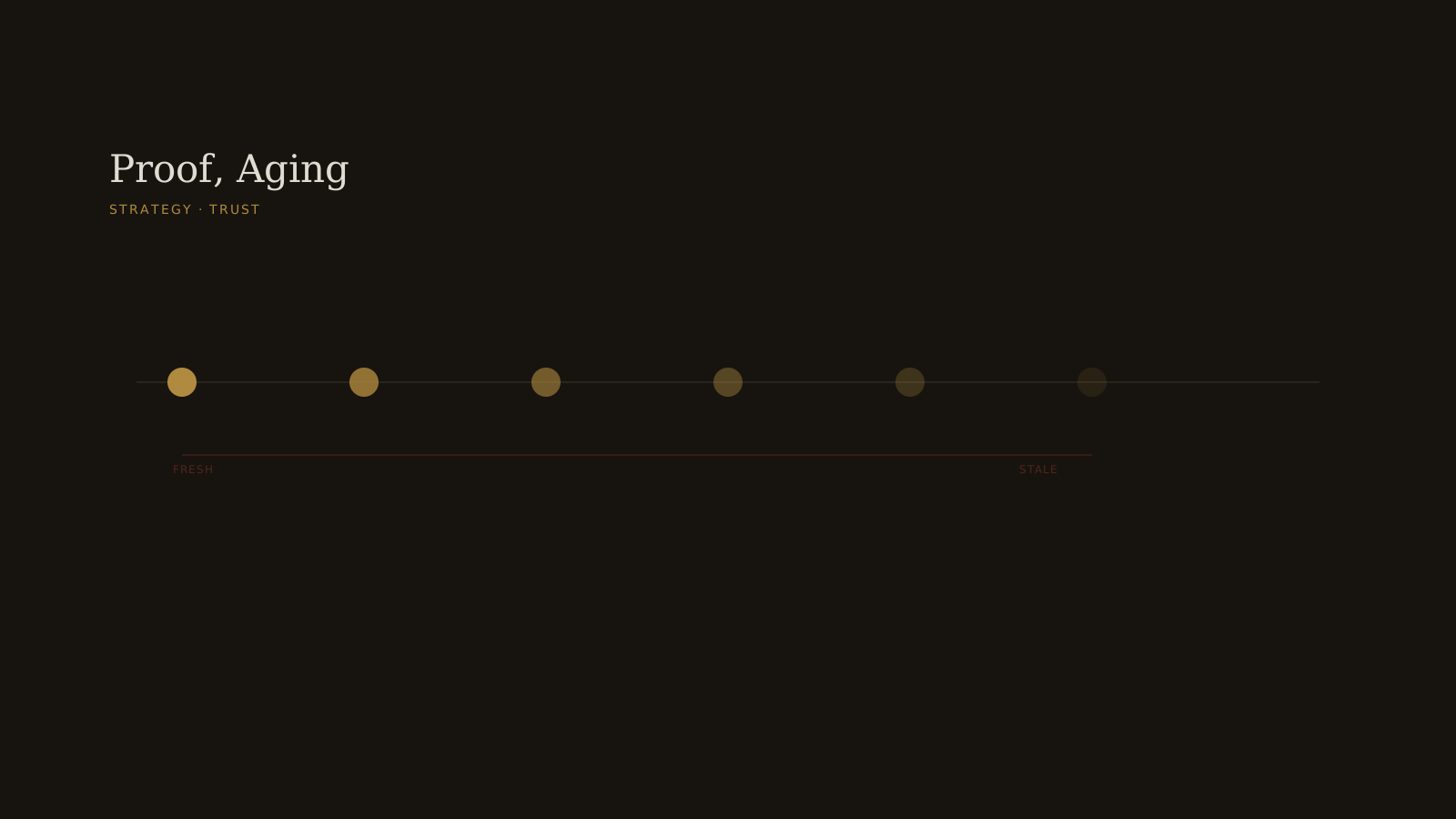
A testimonial has a shelf life. So does a press logo, an award badge, and a screenshot of a social post that did well eighteen months ago. Founders treat all of these as permanent assets - publish once, embed on the homepage, forget - when they’re closer to produce. Some of it spoils.
Three ways proof goes stale
The product changes faster than the proof. A testimonial praising a feature that’s since been deprecated, or a price that’s since gone up 40%, isn’t neutral anymore - it’s a small, specific inaccuracy sitting on the homepage, and sharp customers notice the gap between what’s praised and what’s actually shipped today.
The context ages out. “As featured in” a publication that’s since shut down, or an award from a year when the category had four entrants instead of forty, reads as padding, not proof, to anyone who checks.
The voice stops matching the brand. A testimonial written in a register the company has since moved away from - overly formal, oddly casual, translated clumsily - starts to clash with everything else on the page, and clashing proof is worse than no proof, because it signals inattention.
Why this keeps happening
Nobody owns it. Logos and quotes get added during a launch sprint by whoever’s building the landing page, and then the page ships and nobody is assigned to revisit it. There’s no equivalent of a content calendar for trust signals, so they just accumulate, like old browser tabs nobody closes.
What a working version looks like
Treat the proof section of a website the way a decent engineering team treats dependencies: with a scheduled audit, not a one-time install. Twice a year, someone should read every testimonial, every badge, every stat out loud, and ask a blunt question - would a skeptical customer, reading this today, believe it, or roll their eyes? Anything that doesn’t survive the question gets cut, even if cutting it means the page looks a little emptier for a while. A thinner page of proof that’s all still true beats a dense one where a third of it quietly isn’t anymore.