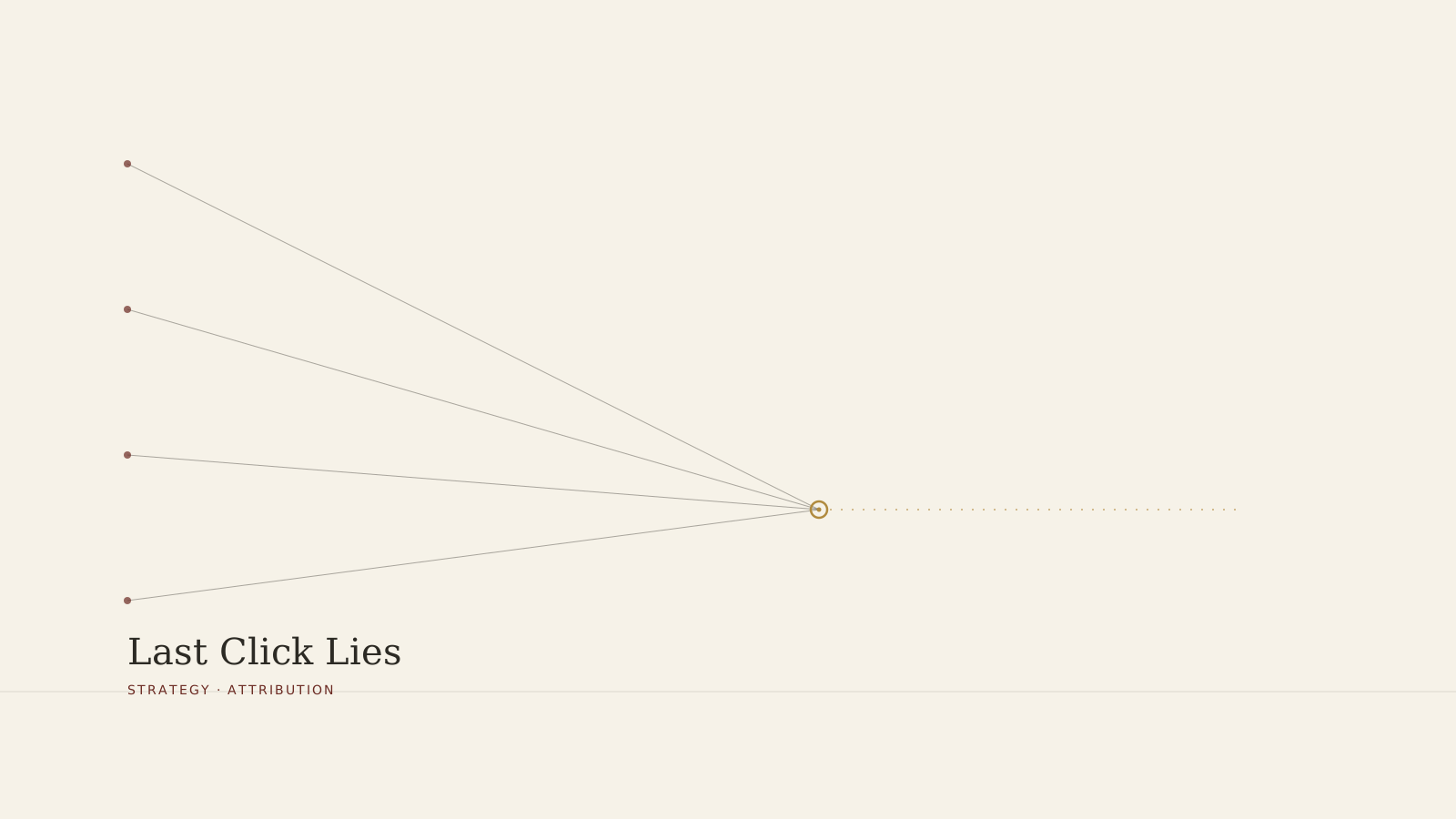
A founder we’ve watched closely ran the same experiment most founders eventually run: she pulled up the attribution dashboard, saw that 40% of signups were credited to “Direct / None,” reasoned that direct traffic meant people already knew the brand, and started cutting spend on the channels that didn’t show up anywhere in the dashboard at all - the podcast guesting, the founder’s LinkedIn posts, the one long interview on a niche YouTube channel. Three months later, growth had slowed and nobody could explain why, because the dashboard had never been built to explain why in the first place.
What the dashboard is actually measuring
Attribution tools record the last thing a browser did before a conversion event fired. If someone heard a founder on a podcast, forgot about it for six weeks, saw a friend mention the product, and finally typed the company name into Google, the dashboard credits “Organic Search” or “Direct.” The podcast - the thing that actually made the sale possible - gets nothing. Not because it didn’t work, but because the tooling has no field for “built trust two months ago in a way nobody can click on.”
This isn’t a bug anyone forgot to fix. It’s structural. Attribution models can only count what leaves a digital fingerprint in a browser, and the channels that build durable belief in a brand - being interviewed, being quoted, being recommended by a person rather than a platform - are specifically the channels that don’t leave one. The dashboard was never lying in the sense of being wrong about its own numbers. It was lying in the sense of answering a much narrower question than the one the founder was asking it.
The channels that get punished for working
Earned media, founder visibility, and word of mouth all suffer from the same measurement gap, and it’s not a coincidence that they’re also the channels that compound instead of decay. A paid ad stops working the day the spend stops. A trust impression from a well-placed interview keeps influencing a buyer’s decision long after the interview is forgotten as a specific memory - which is exactly why it shows up in the dashboard as nothing at all. The channels most vulnerable to being cut on a spreadsheet are, perversely, the ones doing work the spreadsheet can’t see.
Performance marketing doesn’t have this problem, which is part of why it keeps winning internal budget fights it shouldn’t always win. A rupee into a retargeting campaign produces a number in the same dashboard, in the same week, attributed cleanly to itself. That doesn’t make it the better rupee. It makes it the more legible rupee, and legible has a way of beating effective when budgets get reviewed in a hurry.
What to track instead of what the dashboard offers
Three signals tend to tell the real story better than last-click ever will. First, branded search volume over time - not whether someone converted, but whether more people are typing the company’s name into a search bar at all, which only grows when something off-platform is making people curious. Second, a single required field on every signup or sales call: “how did you hear about us,” read as free text, not chosen from a dropdown that only lists the channels already in the dashboard. Founders who’ve done this are routinely stunned by how often a podcast or a specific LinkedIn post gets named by hand, weeks after the model credited the conversion to search. Third, sales cycle length for leads who can name a specific piece of content or coverage versus leads who can’t - the former almost always close faster, because they arrive already half-convinced.
None of these are as clean as a dashboard with percentages next to channel names. That’s the point. A number that’s easy to read isn’t the same thing as a number that’s telling the truth, and a founder cutting spend by dashboard alone is optimizing for the metric that’s easiest to screenshot in a board deck, not the one that’s actually growing the company.