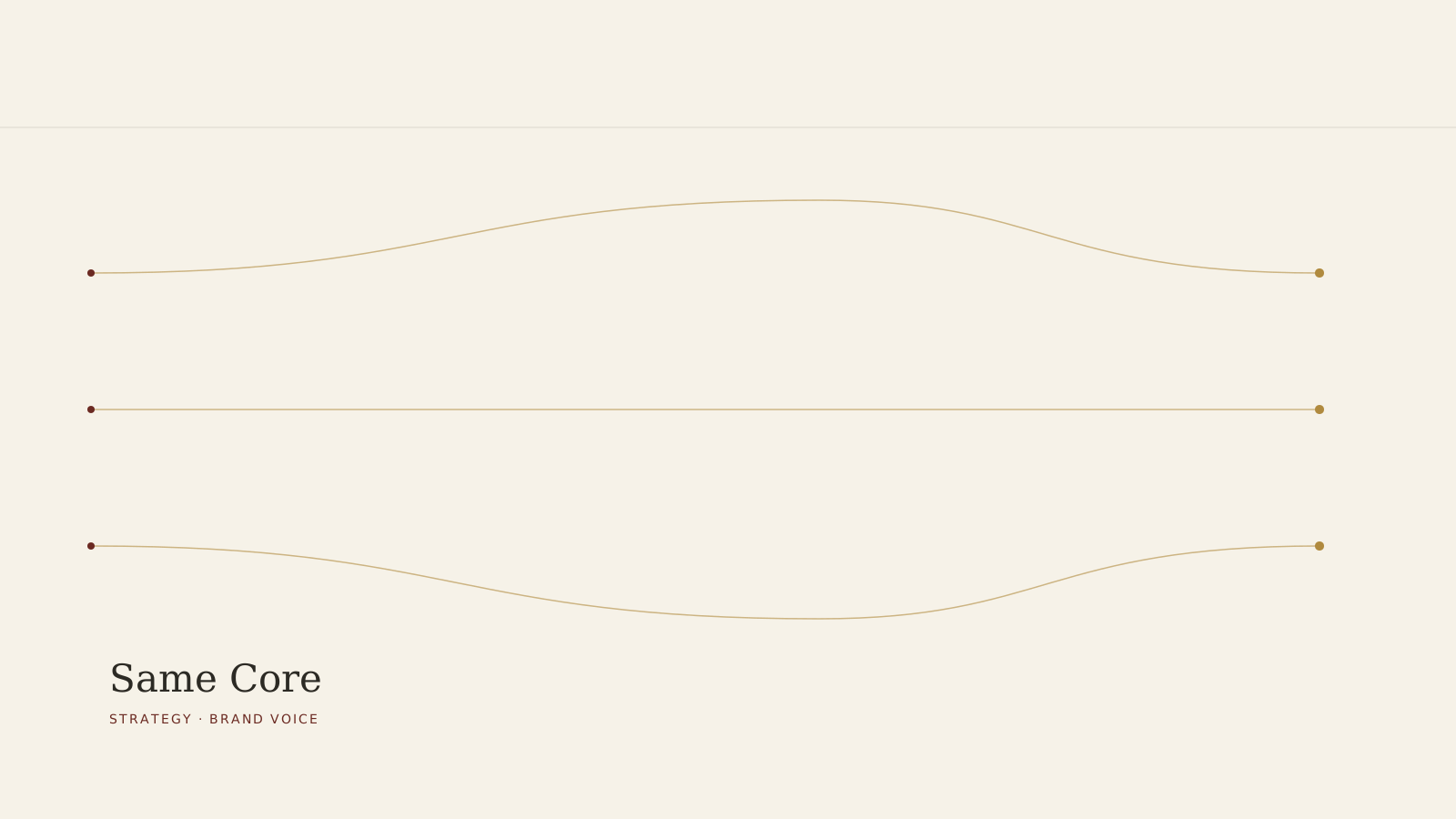
Most founders hear “brand consistency” and reach for a tone-of-voice document: three adjectives, a list of words to avoid, instructions to sound the same on the website, the app, the WhatsApp broadcast, and the founder’s own LinkedIn. The result is a brand that reads as flat wherever you find it - competent, inoffensive, forgettable - because sameness and consistency got treated as synonyms.
They are not the same thing.
What’s actually supposed to stay fixed
Consistency is about a small number of things staying fixed: what the brand values, what it refuses to do, the claims it’s willing to stand behind in public. That’s maybe five decisions, made once, revisited rarely. Everything else - sentence length, humor, formality, how much a post explains versus assumes - is execution, and execution should flex hard by channel.
A support reply during an outage should sound nothing like a product page. A founder being interviewed on a business podcast should sound nothing like the same founder answering a customer’s DM. If they sound identical, one of those two moments is wrong for its audience, and usually it’s the DM - stiff and corporate when it should read like a person typing fast.
Where this breaks in practice
The pattern we see most often: a founder writes a brand guideline that specifies tone down to the sentence level, hands it to every team touching customers, and then watches the brand go quiet and uniform across every surface. Nobody violates the guideline. Nobody sounds like a person either.
The fix isn’t fewer rules. It’s rules at the right layer. Fix the values and the red lines. Leave the register open, and trust whoever is writing the WhatsApp reply to know that WhatsApp isn’t the annual report.
The test that actually works
Read a support ticket reply, a product page, and a founder’s conference answer back to back, with the brand name covered. If none of them could plausibly be a different company, and none of them sound interchangeable with each other either, consistency is working the way it’s meant to. If all three sound like they were run through the same filter, the brand has traded a voice for a uniform - and most customers can tell the difference even when they can’t name it.